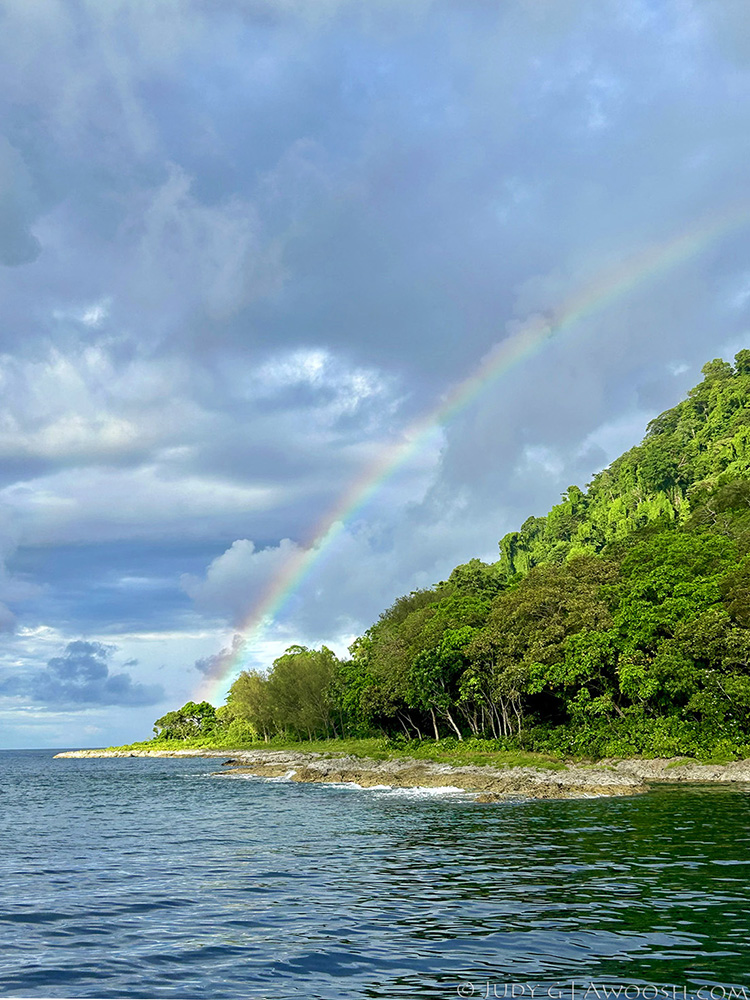
Let me tell you a bit about a land far far away, in the western reaches of the tropical Pacific, closer to Papua New Guinea than to any other landmass. It’s an equatorial archipelago nation comprised of over 1000 islands. The smaller islands are postcard perfect tropical islets, populated by groves of coconut palms and fringed by impossibly white sandy beaches and/or mangroves, and dotted with occasional small villages. The larger islands are mountainous (volcanic in origin) — with dense, green slopes levelling out into wide, rolling, cultivated patches of land, crisscrossed by rivers running away from the mountains to the sea, and by rudimentary roads.
How do I describe the indescribable? Kenya is physically vast and diverse — arid, lush, flat, mountainous, populous (Nairobi), unpeopled (Meru National Park), mystical (the indigenous Samburu), and at times bizarre (the animals). It’s both serene (the landscape), and cacaphonic (the birds). No matter where you go, it is a highly sensory experience.
And wild Kenya is a feeling — even harder to define — awe, a deep immersion into the natural world, the heartfeels of connection.
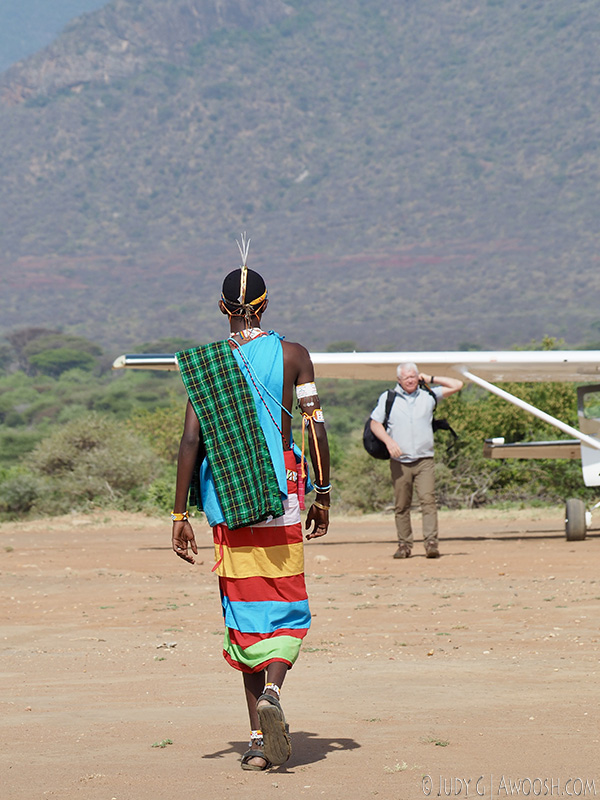
Our flight out to Meru National Park was from Wilson Airport, from which most small domestic flights depart in Nairobi. The plane was a single engine, 12 seater Cessna Grand Caravan, and quite comfortable for the ~45 minute flight to the bumpy, unpaved airstrip in the middle of nowheresville on which we landed.
Once again my words and photos really can’t do this experience justice.
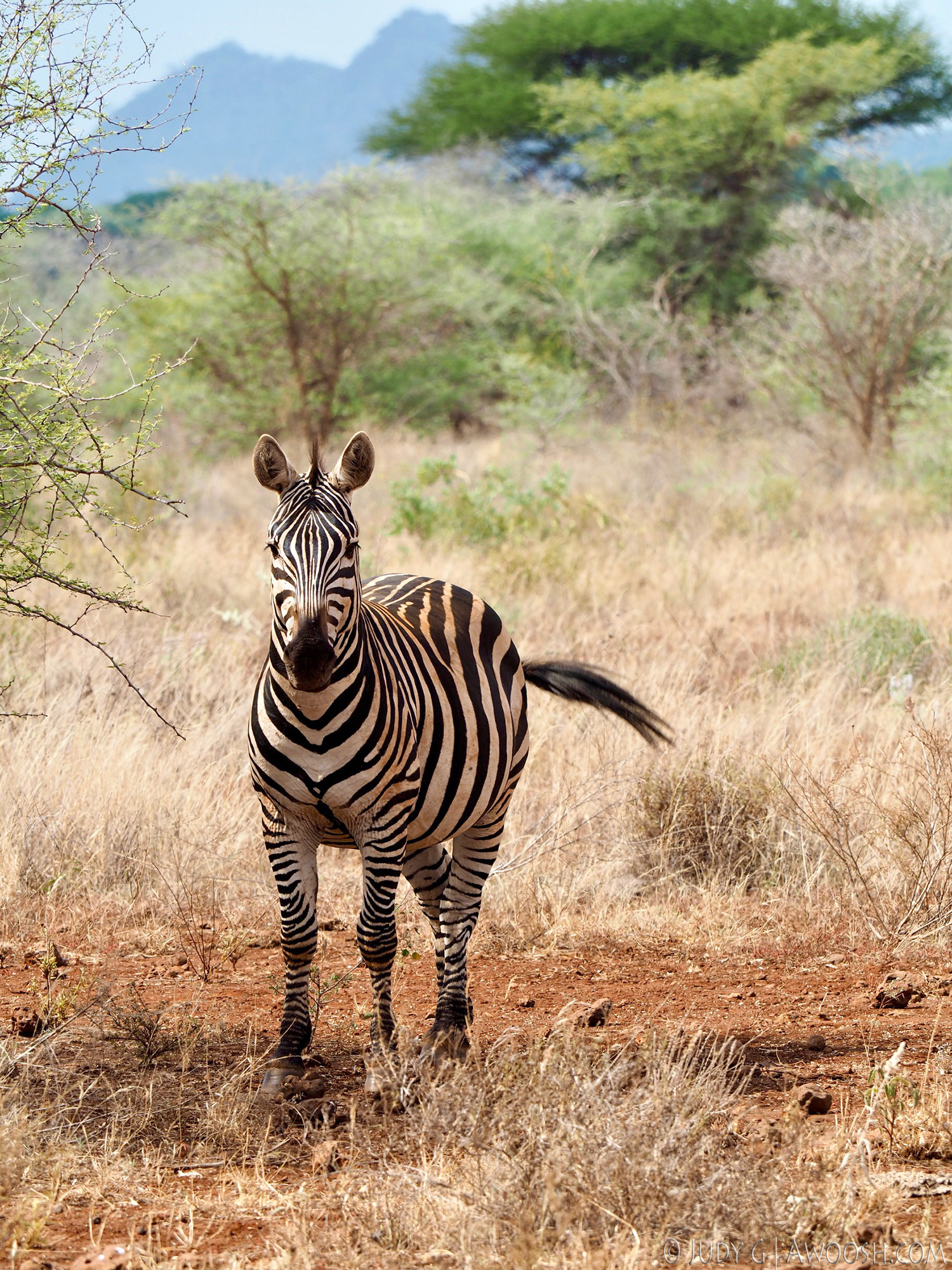
Sarara Camp is located in a wide valley, with epic views from its rocky perch on the flank of a precipitous mountain, all the way across to the scenic Mathews range rising out of the plain on the far side. The land and rocky formations are mostly reddish — and that red oxide tinged soil is important in the rites and rituals of the local tribe — the Samburu. Trees, bushes, grasslands and sandy river flats make up the terrain in the wide valley, which is cut through with rutty, dusty roads. Animals — both domestic and wild, roam freely (there are no fences anywhere), and they all somehow, for the most part, peacefully co-exist.
Maasai Mara North Conservancy – Elewana’s Elephant Pepper Camp
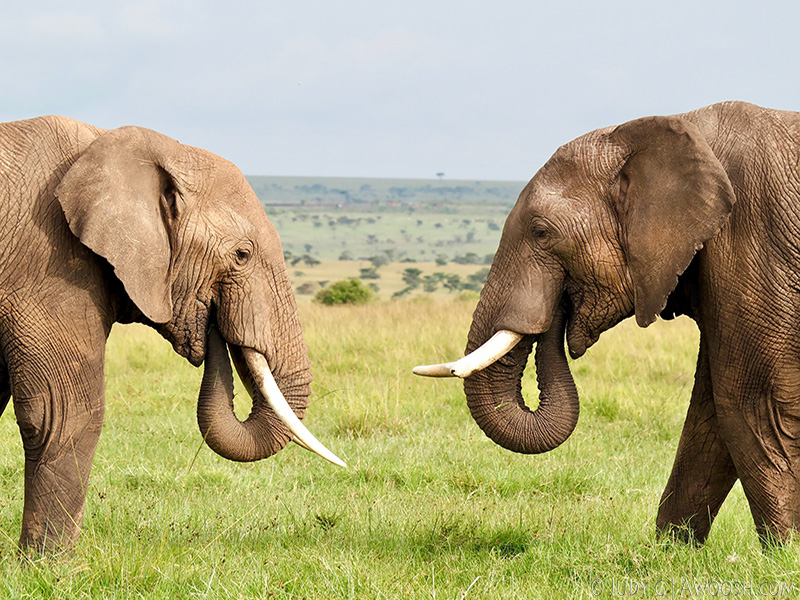
It was a sad farewell to Sarara — all of us left there with full hearts and feeling very inspired by the amazing conservation and social enterprise model that the Samburu and the Sarara Foundation have created together. But we were also ready for some more full on African safari game drives, and our last camp, Elewana’s Elephant Pepper Camp, located in the North Conservancy of the Maasai Mara, did not disappoint.
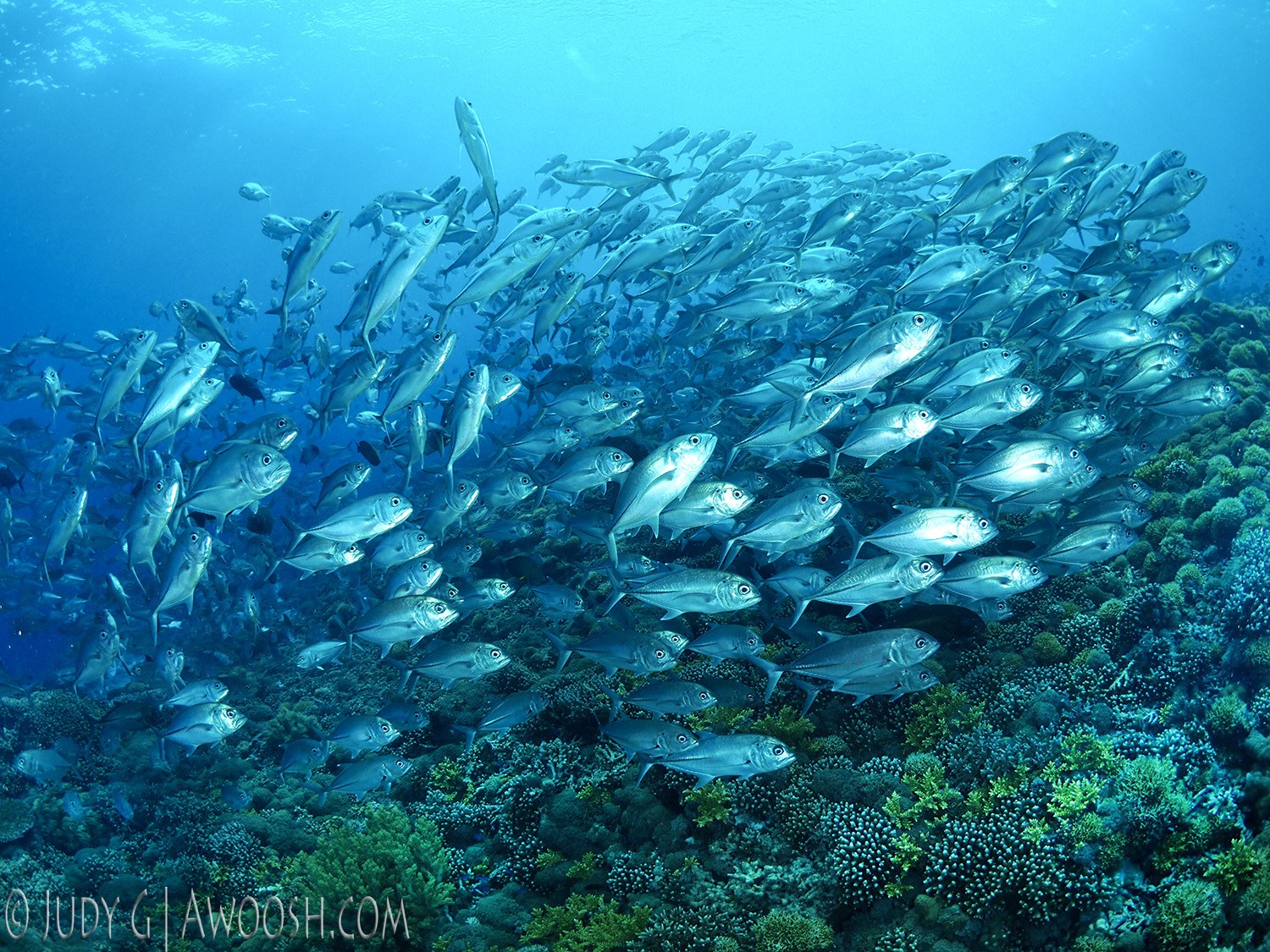
Nothing warms my heart more underwater than seeing an aggregation of fish while diving on a healthy reef. We saw swarms of schooling Trevally (Jacks) on several dives in Tubbataha. Like starling birds, they swirl and undulate and create momentary patterns, swimming with energy and a collective purpose to be at one with a pack of fish – safety in numbers from predators being the reason to be part of a gang.
Being shiny, silvery fish, that are constantly on the move, they can be a bit challenging to photograph, as light from the strobes can easily over-illuminate the Trevally closest to the camera. Shot with an 8 mm fisheye lens in a dome port, as were all of my wide angles on this trip.
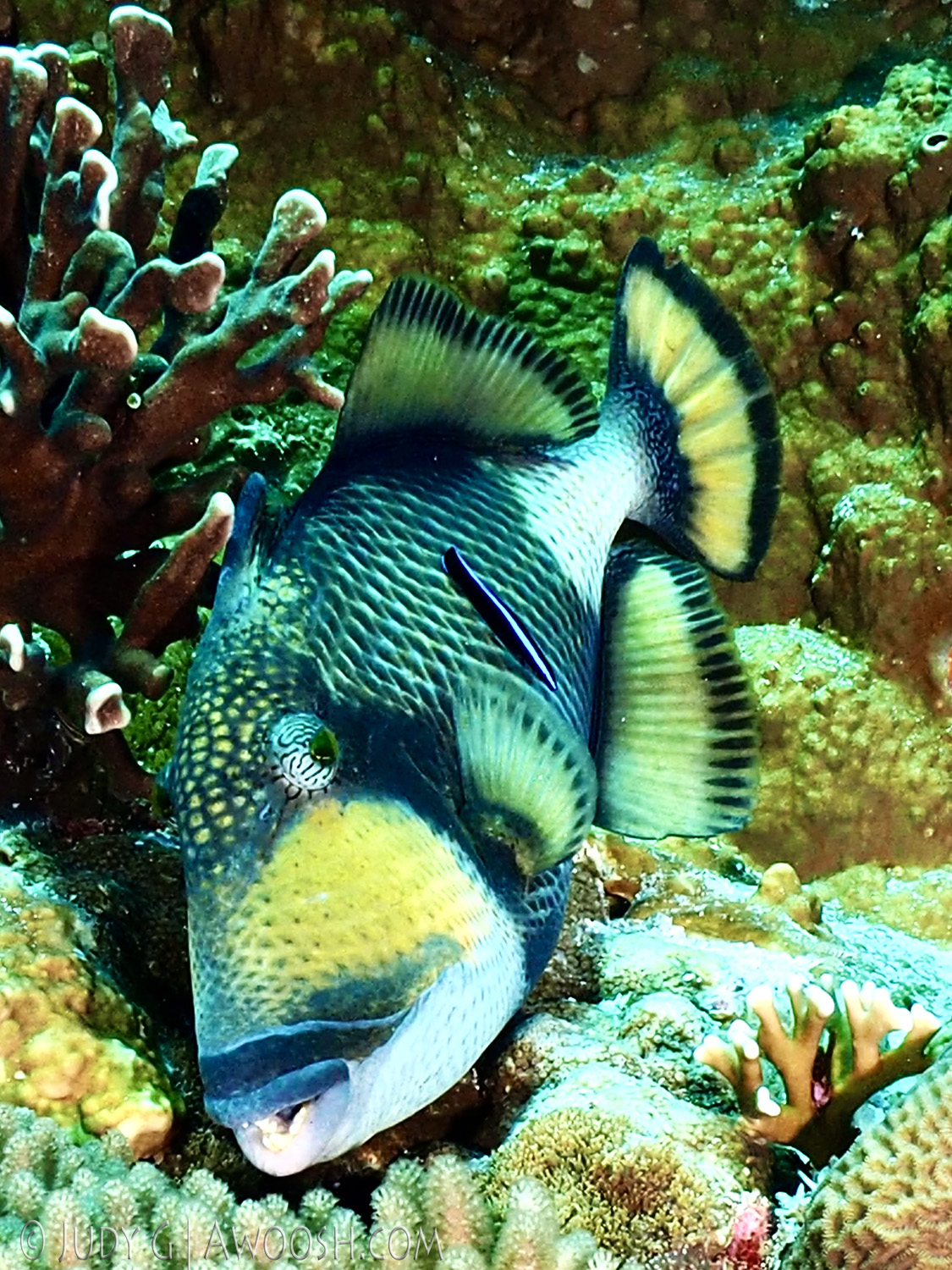
Let me introduce you to the scariest (to me) fish in the sea.
This is a kind of fish that I have nicknamed Bucky (or Buckette – the sex of this fish is not easy to discern by its colouration) – a Titan Triggerfish. Bucky (& Buckette, when she is not nesting) are big, beautiful, and generally benign fish – they grow up to 30 inches in length, and are pretty beefy. Like parrotfish, Titan Triggerfish use their not inconsequential teeth to rip up chunks of coral and crunch spiny urchins as part of their diet.
The other evening we were sharing some of the highlights of our really memorable recent trip to the Tubbataha reefs in the Philippines with some non-diving buds, over beers at the local pub. The first question from an inquisitive friend was ‘How deep did you go?’. I teased him for not asking about what we saw/what made the diving so special/etc, but I get that non-divers are intrigued about what it’s like in the depths, and worry about how risky going deep might be. For me, I only go as deep as I need to try to capture a shot. (I’m not going to ‘fess up about a really deep {planned} dive, well below recreational limits – which is 130 ft – that I did with a bunch o’ adventurous divers in Cozumel quite a few years ago ). Generally, I’ll choose to max out at about 90 feet, unless there is a compelling reason to dive deeper, which is rare. Slow ascent and a long safety stop, as well as diving enhanced oxygen Nitrox instead of straight air, all contribute to keeping this pretty safe to do, even when doing multiple dives per day.
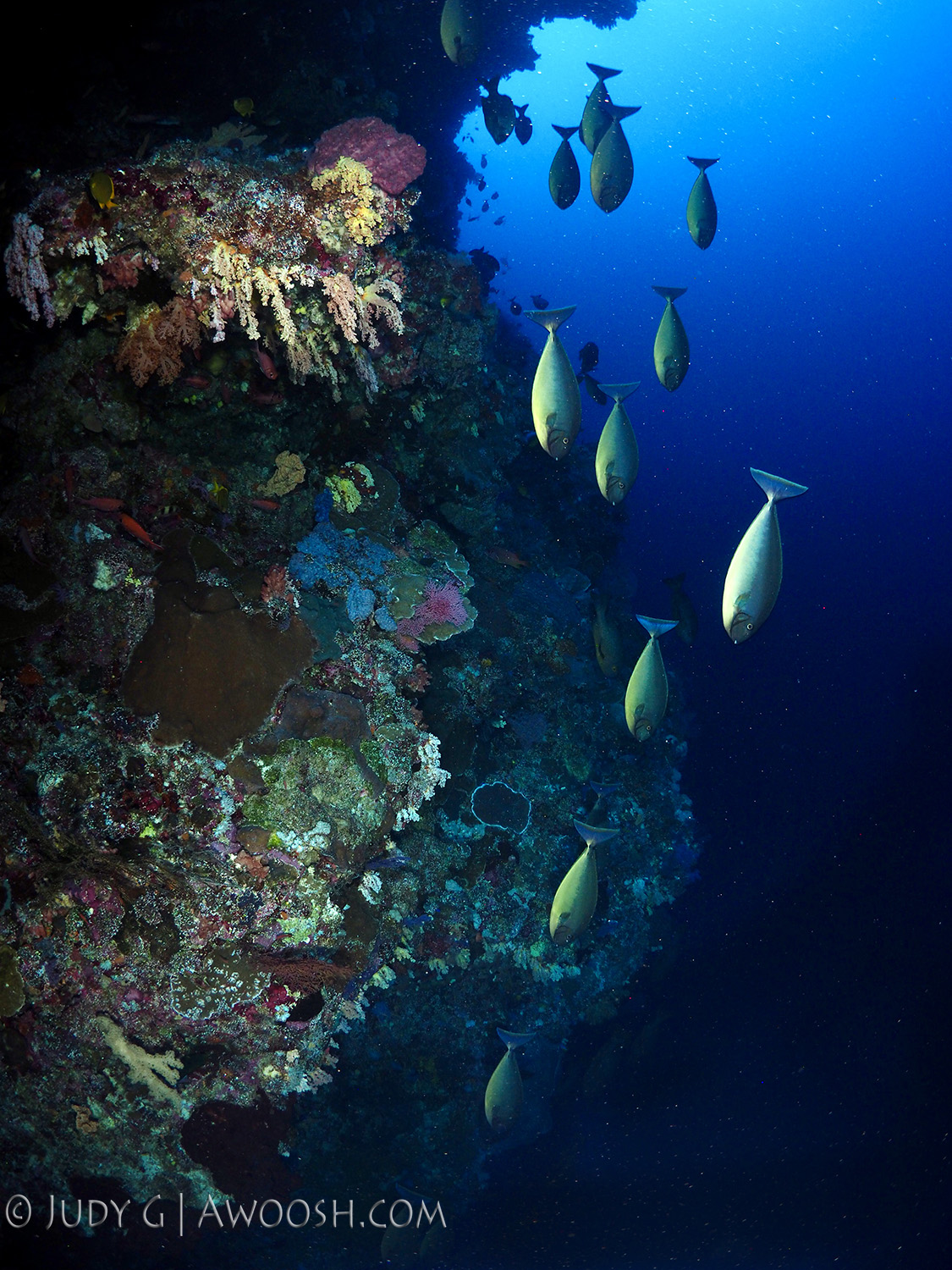
I captured this shot on the recent trip in the Philippines at about 90 feet, and it was the deepest I dove. I went down to try to capture the magic of a waterfall of these surgeonfish, which cascaded from the flat reef above – which itself was at about 50 feet. I like the moody blues, especially evocative on an early morning dive, before the sun is fully overhead. My photo can only hint at the awesome sight of hundreds of fish pouring off the reef above to dive into the depths, which, off the edge of the fringing reefs of the Tubbataha atolls, is thousands of feet deep! Truly, the abyss…
We recently returned from a truly wonderful dive trip to Indonesia. After the stress-inducing O-ring debacle of the diving portion of our first adventure post-Covid, in Egypt‘s Red Sea, this was relaxing, exhilarating, and breathtakingly beautiful diving. (Note: You’ll need to scroll waaaaaay down to read about our fubar diving in my Egypt trip report ;^).
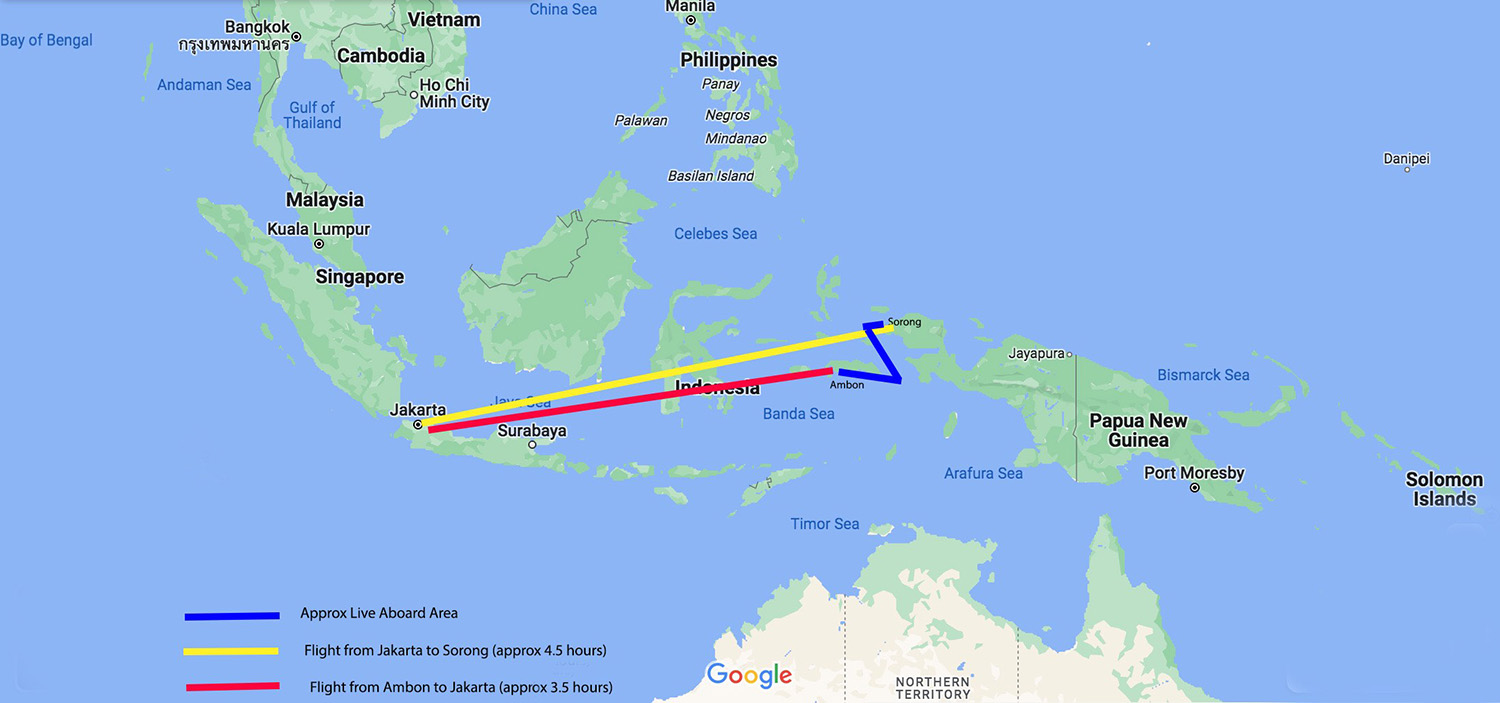
On this trip, most of the gang (comprised of the usual suspects) spent a few days – before setting sail on a 10 day live aboard trip – doing some nice land based diving out of a resort in northern Misool, a remote area located in the far eastern reaches of the sprawling island nation of Indonesia.
To get to this part of Indonesia it’s for sure an adventure – for us, a long haul flight from the west coast of Canada, then a quick connection in Singapore to a flight to Jakarta, and then a red eye 4.5 hour flight from Jakarta to Sorong (aka So Wrong ;^) – we called it that because on a previous flight out of this non-touristy place, the ancient 737 that we were on barely made before the end of the quite short runway – I swear it must have been skimming its wheels across the wave tops as it struggled to get airborne. Hot, heavy, and humid were the conditions that day – all perils in flying. The flight was crammed to the max with sweaty bodies – every seat was taken, the overhead bins were stuffed to overflowing, as no doubt was the luggage compartment in the belly of the beast. I won’t even get into the malfunctioning loos in the rear of the plane which permeated the cabin with an incredibly foul miasma of septic gases for the duration. It was definitely a ‘suck it up buttercup’ kind of situation. Still, the diving in the area was so good that, despite the sketchy Indonesian-operated flights required to get there, there we went again. (Here’s a link to my previous trip report on Raja Ampat, from 2010).
Where in the World Were We?
I’ll write more about the land-based resort we visited in a future post, and a bit as well about the superb live aboard that we all greatly enjoyed (seriously, we all loved it so much that we are already looking to book a future trip).
But for now, I thought I’d start by sharing some images from the trip in some short photo blogs. I have already shared the following images on my social media (Judy G Diver on both Facebook & Instagram), but thought I’d drop them in here too.
Rush hour at Boo Rock, Raja Ampat, Indonesia, April 2023.
That’s Amy D going to with a massive Bumphead Parrotfish – one of about a dozen there that day. We saw schools of these big beauties on several other sites as well. This sighting was particularly lively as they hung around in the swirling current, audibly chomping on the beautiful reef.
Rush Hour in Raja Ampat Part 2. This is a school of silvery Jacks – just one of many species of schooling fish that we spotted on the trip.
It warmed my heart so much to see abundant, healthy and diverse fish populations and reefs in this part of Indonesia – no doubt due to an established marine protection zone, which appears to be working quite well.
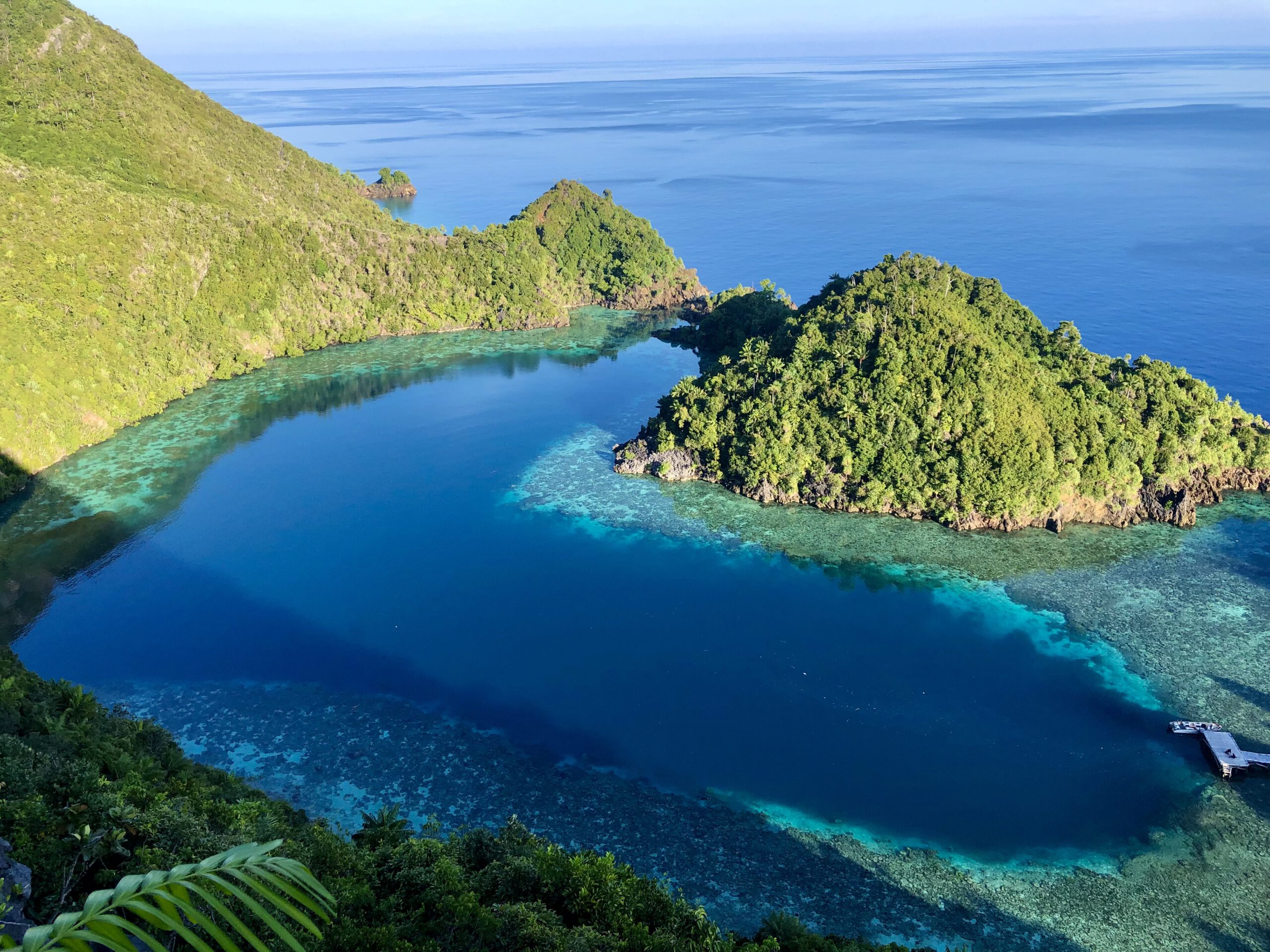
Heart Lagoon, Raja Ampat.
A fairly short, very sweaty, steep sketchy wooden-stepped hike to this viewpoint of a gorgeous shaped lagoon. This was the only time we went on land during our 10 day live aboard trip.
I’ll admit that I was never super interested in ancient history; I think my last whack at it was in the early years of high school. Egyptians, Romans, Greeks? They were bygones to me – more mythology than history in my hazy lazy memory. What had always interested me more was modern times — 19th and 20th century. To me, these were the events that formed our modern world, and I have usually sought out museums and experiences that feed into this silo of interest.
But during a planned group dive trip with a bunch of the buds to the Red Sea, with an option to add on a week touring in Egypt, I found that I really started to groove on the ancient, and became increasingly fascinated with the incredible architecture (how the heck did they do that?!), and pictorial language. Hieroglyphics tell the story of who the ancient Egyptians were, what they believed in, and how a civilization of people lived thousands of years ago.
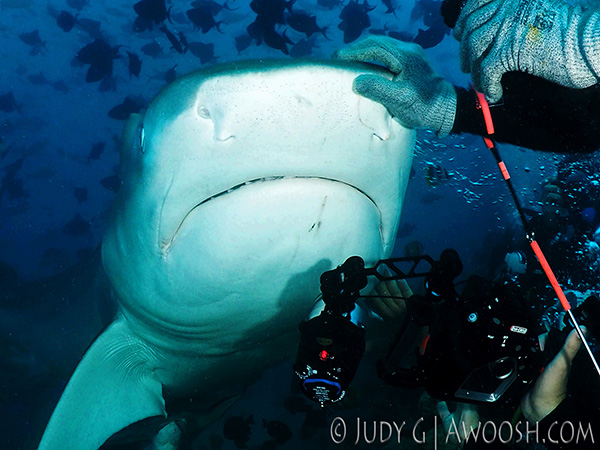
Massive tiger sharks. Big beefy bull sharks. Marauding reef sharks. Thick clouds of thousands of fish. Dive masters swimming up into this chaotic melee to dump fish guts in murky mid-water, in an effort to attract the big ‘uns. Twenty-six divers lined up behind a low berm, just feet away from the bait buckets. What could possibly go wrong?
Yesterday was the much-anticipated solar eclipse. And although we live a bit north of the ‘zone of totality’, it was still a noteworthy happening. And amazingly, it was a clear sunny day for this extraordinary event.
It had been over a year since we last donned the drysuits and waddled into the water. It’s totally awesome to be shore diving in the front yard, but the bods are not getting any younger, and contorting into the cold water gear and heavy weight harnesses, shuffling down a bumpy beach, wallowing around in shallow water to get the fins on, and finally swimming out to drop down are really not for the weak of heart.
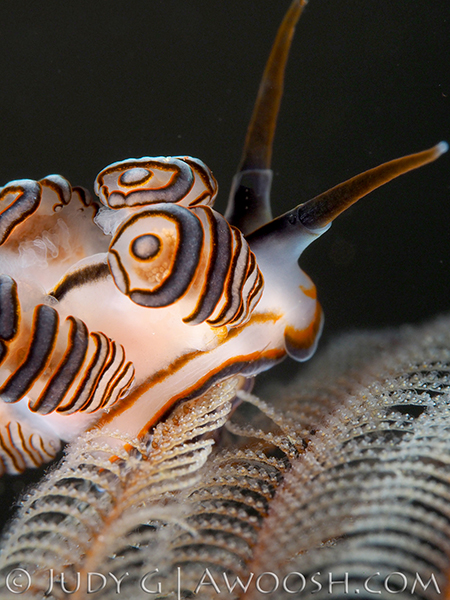
From the Bali files. This is the front end of a teensy Doto nudibranch, feasting on a hydroid.
There are thousands of species of nudibranchs (aka sea slugs), and they come in a kaleidoscope of colours and patterns. Big nudis can be up to a foot long. This little beauty (Doto greenamyeri for all you nudi geeks out there) was about 1/3 of an inch in length. Those horn things (rhinosphores) are how they smell/sense. Shot with a 60 macro lens and a +10 diopter, plus a whole lotta cursing .
This is a fairly unusual critter – so much so that it is not in my (older version) Humann & Deloach Caribbean Reef Creature ID book. It is a Pen Shell Shrimp (Pontonia mexicana), about half an inch in length, which I photographed in March in the Caribbean muck diving mecca that is St Vincent. I was pretty astonished at how many new (to me) critters we saw on that trip. More to come…
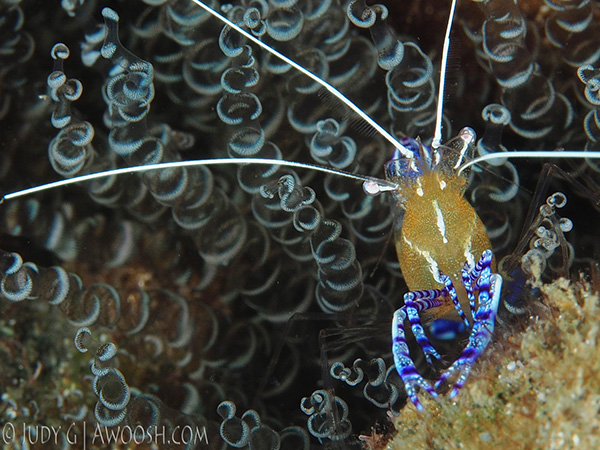
Pederson shrimp on a corkscrew anemone. Photographed in St. Vincent.
St Vincent is known for coughing up some pretty weird and wonderful species, some of which are seen no where else in the Caribbean. I initially thought this might have been something pretty unusual for the Caribbean, but stand corrected by those with better ID ability than me .
These wee beauties (max about an inch in length) typically live in what is called a commensal relationship with their host anemone. It’s considered commensal when one species (in this case the shrimp) benefits from the other (in this case the toxins from the anemone, which coat it and protect it from predation), while the host neither benefits, nor is harmed, by its presence. So it is different than a mutualistic relationship (ie an anemone fish and its host anemone, like I wrote about last week), in which both creatures derive benefits from the other. And that is in turn different than a parasitic relationship, in which one species (ie a copepod) benefits, while its host suffers. There is a photo earlier in my Instagram feed that shows a little red/pink bottom dwelling fish with ‘a party hat’ on its head. That thing on its head is actually a nasty parasite.
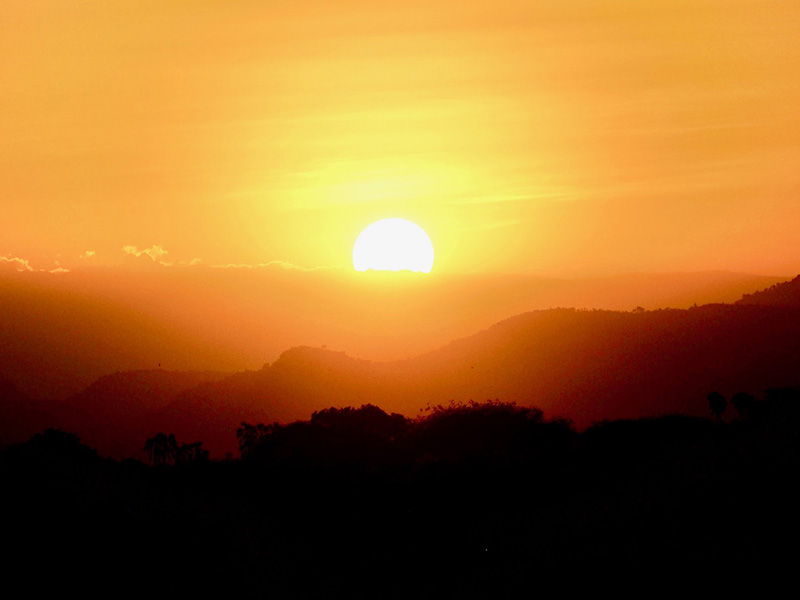
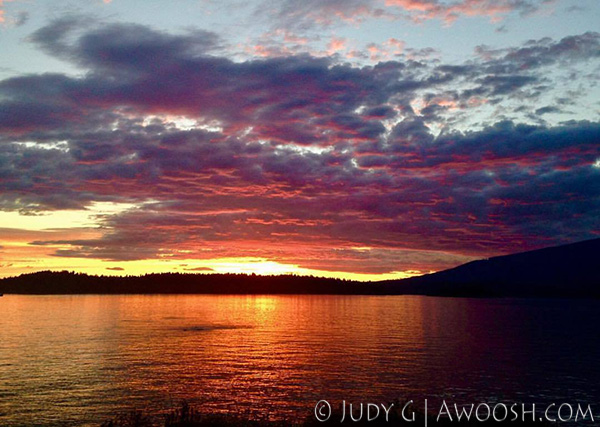
Sunsets are always beautiful, fleeting things, but every now and then they transcend into the truly spectacular. This was one of those sunsets. Taken from the stern of a live aboard dive boat, in eastern Indonesia, with a yummy rum punch in one hand, and a camera in the other, surrounded by (oohing and aahing) great buds.
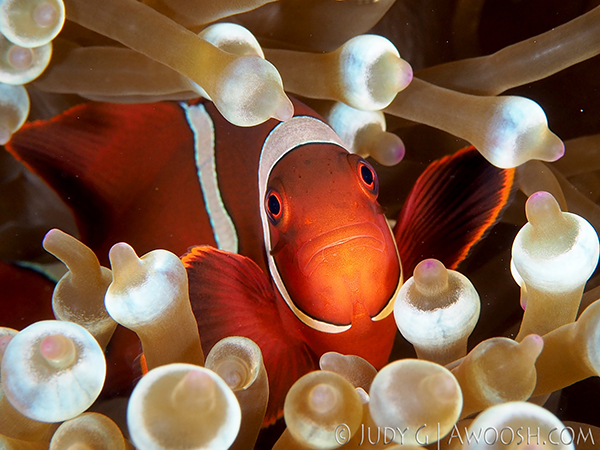
My diving buds know that I am a bit nuts about anemone fish. I just can’t swim past an anemone inhabited by these cute and colourful little fish without trying my luck at getting a pleasing shot. They are frustrating to photograph though, as they are in perpetual motion. They scoot all around and burrow into their host anemones, especially when divers or other perceived predators approach. Patience is required 😉.
Anemone fish and their host anemones enjoy a fairly complex symbiotic relationship – among other mutual benefits, the anemone fish aerates the anemone with its constant motion, and possibly attracts prey to the anemone (which is a carnivorous, stationary animal, with a mouth). The little fish rub themselves frequently on the anemone to coat themselves in the anemone’s toxins, to which they are immune, and which protects them from predators. Quite often there will be a mated pair, and sometimes a family with little ones, living on a single anemone.
This Spinecheek Anemone fish (a cousin of Nemo) was alone in his little bubble anemone, so probably a juvenile just starting to live independently. If there had been a female Spinecheek with him, she would have been larger, and a darker, duskier red. All anemone fish start out as males. They undergo sex change to female based on social order, so this little guy very well could be a mama soon.
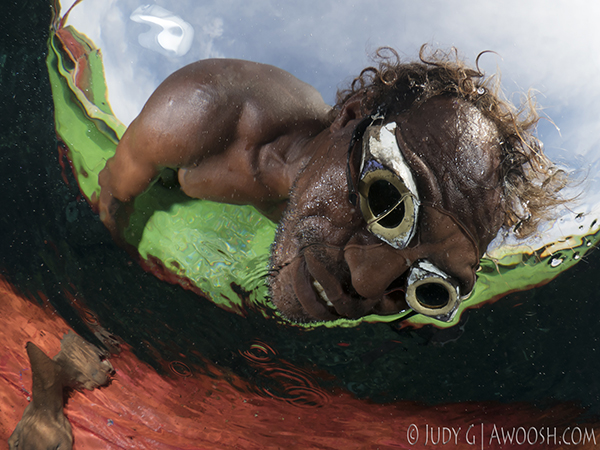
And now for something a little different. This fellow peering down at me as I took pictures from under his canoe is a local fisherman in the Alor area of Indonesia. These guys hand make bamboo fish traps, and place them on the reef. Then they paddle their side rigger dug out canoes to the traps, and use their hand made goggles to look down and keep an eye on them. They also free dive to spear fish.
The hardest part about getting a shot like this is holding your breath for long enough that you don’t get your exhaled bubbles in the shot.
One of these days, I really should do a write up for this trip. The diving was wonderful – an excellent combination of muck and gorgeous reefs. Topside was interesting as well – some very pretty sunsets, lovely mountain islands dotted with rural villages, and behemoth blue whales, spotted several times!
I have a scary number of underwater images in the hopper – three trips’ worth, truth be told. I have been sharing a few on Facebook and Instagram (you can find me there – Judy G Diver), but I have been slow to mirror the images here on the blog.
So here is one to get the ball rolling (again)…
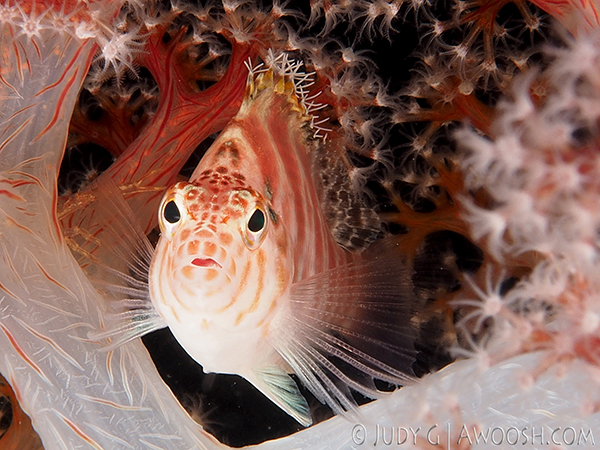
This is a little thread fin hawkfish, perched on pretty in pink soft coral. These skittish little fish (read: very frustrating to photograph) grow to a maximum of 3 inches in length. I captured this image at a depth of about 90 feet, on a muck site, in the Alor area of Indonesia.

 ). Generally, I’ll choose to max out at about 90 feet, unless there is a compelling reason to dive deeper, which is rare. Slow ascent and a long safety stop, as well as diving enhanced oxygen Nitrox instead of straight air, all contribute to keeping this pretty safe to do, even when doing multiple dives per day.

 to
to 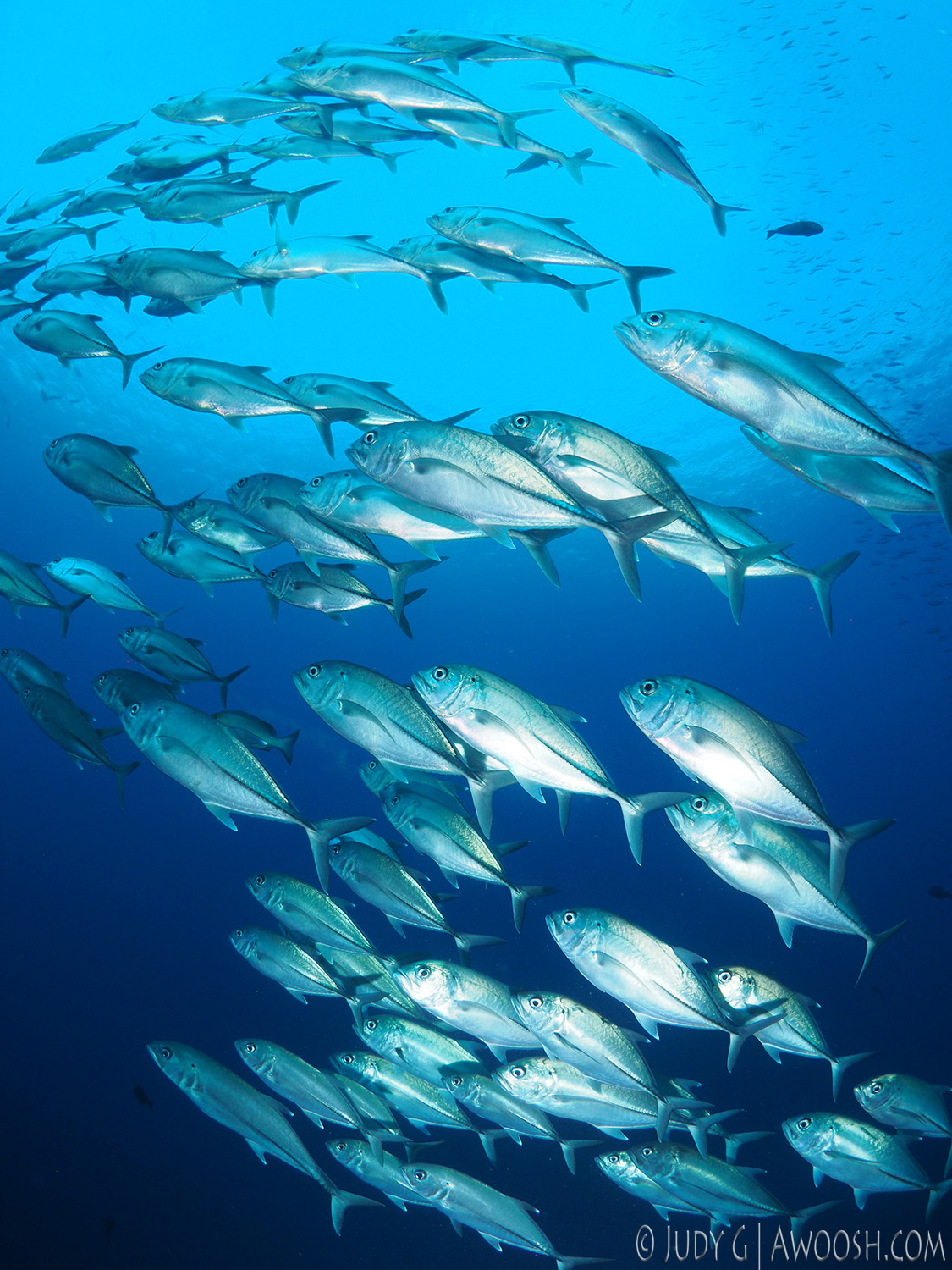
 shaped lagoon. This was the only time we went on land during our 10 day live aboard trip.

 .
.